
 On August 19, 1991, I stood at the public boat launch on Provincetown’s West End as Hurricane Bob made landfall with 100 mile an hour winds. We lost power for days, and many roads were blocked by downed wires. Fortunately, Spiritus Pizza had wood-fired ovens, battery-powered boom boxes played dance music in the streets, and souvenir shops sold “I was blown by Bob t-shirts.” Provincetown knows how to turn a hurricane (or any other excuse) into a party.
Fifteen years ago today, I was scheduled to be the guest preacher here at the Chapel on what became the eve of Hurricane Irene. Expecting a direct hit to Cape Cod, the Chapel cancelled Sunday worship, and we decided to outrun the storm. Irene actually made landfall on Long Island, missed the Cape entirely, and instead, went up the Connecticut River Valley.
The following year, Hurricane Sandy bypassed the Cape entirely to strike New Jersey, before making an abrupt left turn and morphing into a post-tropical cyclone that battered the U.S. North Coast over Lake Erie. Sandy swept across our waterfront backyard in Cleveland, carrying off a patio table, downing an enormous tree, removing portions of our roof and siding, and leaving us without power.
For the last several years, Emily and I have spent part of the winter in Puerto Rico. And there, I’ve heard many stories about the aftermath of the devastating 2017 Hurricane Maria from which the island is still recovering. So, every year, as the tropical storm season begins — with the next one coincidentally named “Dolly” — I hold my breath and pray for all those who live in harm’s way.
This weekend, we’ve had a bit of a storm in our own household. Early Friday morning, our houseguest and visiting preacher, Mark Beckwith, went off to Cape Cod Hospital for emergency surgery. It was successful; he is recovering; and I remain grateful for the Cape’s wonderful hospital.
Since I wasn’t prepared to preach, I went through my files and found the sermon that I never got to deliver on the last Sunday of August 2011. I liked what I had written, so I decided to update it a bit and share it with you this morning.
Now, may the words of my mouth, the meditations of our hearts and the actions of our lives be blessed by Ruach, the sacred wind and spirit of God. Amen.
Martin Bell, in his book The Way of the Wolf, told a story entitled, “What the Wind said to Thajir.” Thajir was a little boy who liked the sunshine, the grass, the trees, and most especially the wind. Whenever there was wind, Thajir would go for a walk. One day the wind spoke to him and said:
Thajir, you are my friend. I would like to tell you something important. Please listen carefully and try to remember what I say. Regardless of what anyone else may ever tell you, regardless of what your own experience may lead you to believe, everything that is, is good. At the center of things, life belongs to life…
And here is another secret that is almost as important as the first…You [Thajir] are the whole of creation – past, present and future. Decisions that you make today…will validate or invalidate everything that has gone before, and make possible or impossible everything that is to come…
And there is something else…the most basic truth…It is in dying that one lives. It is in losing [your] life that [you] will find it…[You will be] united with the origin and aim of life precisely as [you] expend [yourself] on behalf of the entire world.
Thajir took these words from the Wind into his spirit and promised not to forget them.
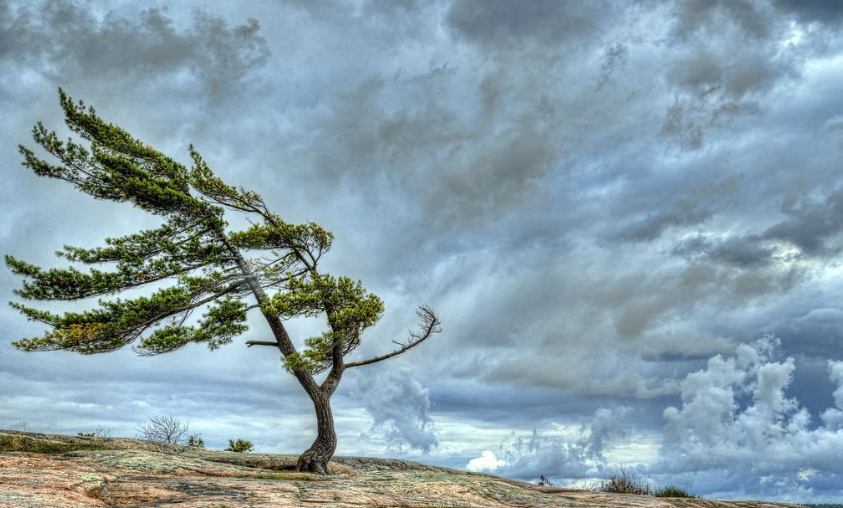
The Hebrew word for God’s spirit is ruach which means, “wind or breadth of God.” I’ll never forget standing on top of a windy hill on a Kibbutz in northern Israel, and hearing a man non-chalantly say, “Ruach is very busy today.” I thought he was talking about God; he was simply speaking of the wind.
During tropical storms, hurricanes, tsunamis. cyclones, blizzards and tornadoes, especially in a time of global warming and rising sea levels, various parts of the earth receive a lot of Ruach – maybe even too much to handle. But as scientists have taught us, storms are, in fact, nature’s ecological pruners, hydrations, thermal engines and safety valves. Without regard for human existence, storms are good for the planet.
In Martin Bell’s parable, when the wind – ruach in Hebrew, riyāḥ in Arabic – spoke to Thajir, it was really the voice of God. Thajir had an experience similar to Moses at the burning bush, Paul on the road to Damascus, Peter on the stormy sea, and even Jesus coming up from the waters of his baptism. Divine wisdom, the breadth of God, set their hearts on fire with the water of faith, the flames of love and the energy of creation.
Children intuitively understand the wisdom of wind, water, fire and earth – thee lements of nature. Just look at a group of children lying on their backs soaking up the energy of both earth and sky. Witness a boy throwing pebbles in the water fascinated with its expanding circles of dynamism. See a girl climb or hug a tree literally touching its strength and healing power. Stand in a classroom of preschoolers and look at the expression on their faces when they discover that the plant on the windowsill or the gerbil in the cage has died; they grieve in ways far beyond our understanding. Watch kids mimicking animals in the zoo, chasing squirrels in the park, or talking back to ducks in the pond. Watch youngsters at the beach building a sand castle, pondering the mystery of a crab, or riding a wave. Or on a windy day, see them facing the wind with their arms stretched wide, receiving all the power of its force head-on. Children know in their very essence that they are connected with the rest of creation.
The non-human creatures of the earth, both great and small, also understand the wisdom of nature and have much to teach us, if we’re willing to observe and learn. The ocean’s tides, with their natural clock, show us the structure of time. From the trees, we learn balance and flexibility. The whales, our close relatives in the sea, illuminate much about our own immune system. The bat teaches night vision, the eagle is a flight instructor, the loon demonstrates the art of tranquility, the rainforest is a dance teacher,
the owl illustrates watchfulness, the wolf gives us permission to howl, and the birds of the sky teach us how to sing and soar.
Creation itself understands wisdom. As the original Genesis myth reminds us, and as we recall at every funeral, we humans come from the earth and to earth we shall return, for all of life is interconnected.
Creation also teaches us that decisions we make today will impact what happens tomorrow. As earth, wind, fire and water – the basic building blocks of creation – become more fierce due to toxicity, pollution and global warming, our future is more threatened. At the same time, dirt, sun and water freely expend themselves, so that other creatures might live. They know the meaning and purpose of sacrificial love, that in losing one’s life, one finds it, and that in giving one’s life away, one is united with the
origin of life.
I am convinced that most children intuitively understand the divine wisdom of nature. They appreciate the magic of a bush that burns but is not consumed. They are enamored by the power of water and wind. They are not afraid to take off their shoes and stand barefoot on holy ground.
But there is a problem, a very serious problem. Too many children are growing up without any exposure to or experience in the world of nature, and are thus not learning its innate wisdom. Far too many young people never see the ocean or even a lake. They’ve not walked in the woods or hiked up a mountain. They’ve not planted a garden or set up a bird feeder. They’ve not surfed waves, built sand castles, collected seashells, or chased crabs. They’ve not faced the power of a gale force wind.
Far too many children around the globe are growing up alienated from the natural world, thus thwarting their natural intuition and inhibiting their natural learning. How will our children know about the importance of protecting natural resources, the environment and the global commons if they’ve never experienced it?
And, at the same time, too many children are left vulnerable to the elements ofnature. Think about the kids caught in those horrific mudslides at the border of Tibet and China, those suffering from water shortages in Puerto Rico, those watching ice melts in the Arctic, and those dying from famine in the desert. Think about our own children and grandchildren, who perhaps don’t live in immediate harm’s way, but are facing an environmental crisis beyond our imagination.
On this last Sunday of August, as we begin another hurricane season, and as our children, along with their teachers and parents, prepare for a new school year, let us listen to the wisdom of Ruach. Let us remember what Thajir learned from the wind — all of creation is good and interconnected. Let us remember what Moses learned from the burning bush — with the fire of God that does not consume, we can do more good than we can imagine. Let us recall what Jesus taught his disciples on the road to
Jerusalem — in dying we find new life. Let us not forget what Paul learned on the road to Damascus and taught to the Christians in Rome — hate what is evil, hold fast to what is good; love one another with mutual affectior, and outdo one another in showing honor. And, as we remember that which our spiritual ancestors experienced and that which nature teaches – let us, with the grace of God, do everything in our power — even that which is beyond our imagination — to honor and protect, our island home. Amen.
The Very Rev. Tracey Lind
St. James the Fisherman, Wellfleet
Proper 17A 2026